How Generative AI Works (Simple Explanation for Beginners)
How Generative AI Works
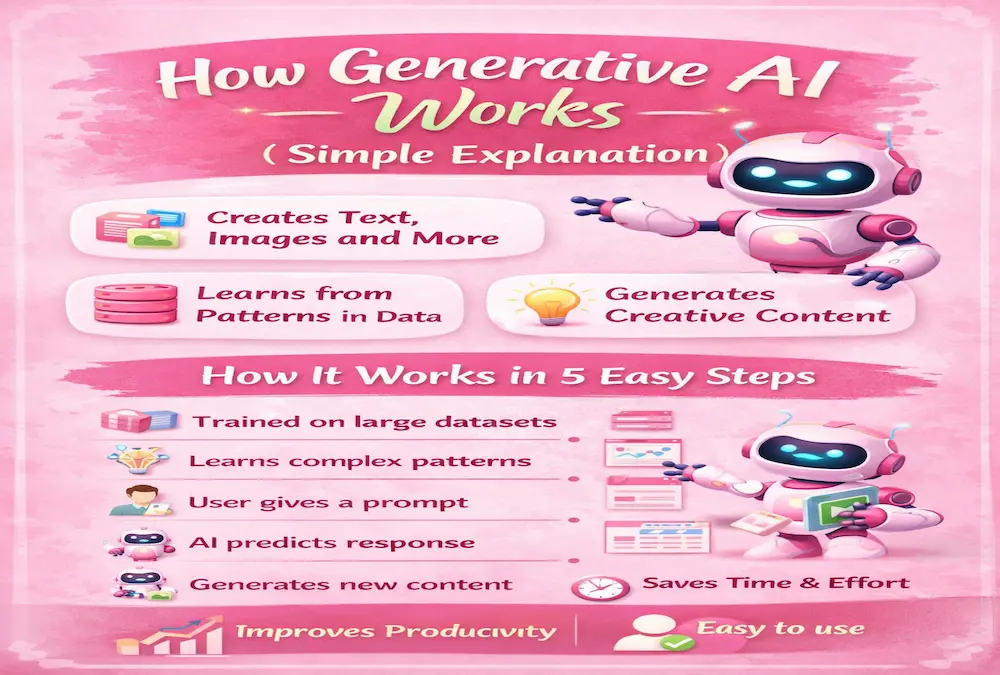
Generative AI is a type of artificial intelligence that can create content. It can generate text, images, music, videos, and even computer code.
Instead of only analyzing data, generative AI produces something new. This makes it different from traditional AI systems.
In this guide, you will learn how generative AI works using simple words. No technical background is required.
What Is Generative AI?
Basic Meaning
Generative AI refers to AI systems that generate new data. They learn patterns from existing information and recreate similar outputs.
For example, it can write an article, design an image, or compose music. All of this happens based on learned patterns.
How It Is Different from Traditional AI
Traditional AI focuses on prediction and classification. It answers questions like yes or no.
Generative AI creates full content instead of just decisions.
How Generative AI Learns
Training with Large Data
Generative AI is trained using massive datasets. These datasets include text, images, audio, and more.
The AI studies patterns, relationships, and structures in the data.
Learning Patterns, Not Facts
The AI does not truly understand information like humans. It learns patterns and probabilities.
This is why responses can sound intelligent but still make mistakes.
How Generative AI Works Step by Step
Simple Process Explanation
- The AI is trained on large amounts of data
- It learns patterns and relationships
- A user gives a prompt or instruction
- The AI predicts the most suitable output
- It generates content based on probabilities
This process happens in seconds. Behind the scenes, complex math models work together.
Popular Generative AI Models
Text-Based Models
Text-based generative AI creates written content. It can answer questions, write emails, and summarize information.
Image-Based Models
Image generation AI creates visuals from text descriptions. It is widely used in design and marketing.
Audio and Video Models
Some generative AI tools can create voices, music, and videos. These are used in entertainment and education.
Key Benefits
Saves Time and Effort
Generative AI automates content creation. Tasks that take hours can be done in minutes.
Boosts Creativity
AI can generate new ideas and inspiration. It helps creators explore more possibilities.
Improves Productivity
Businesses use generative AI to work faster. It helps with writing, design, and customer support.
Accessible to Beginners
Most tools are user-friendly. No coding or technical knowledge is required.
Real-World Uses of Generative AI
Education
Students use AI to understand concepts. Teachers use it to create learning materials.
Content Creation
Bloggers, marketers, and designers rely on generative AI. It helps with articles, ads, and visuals.
Business and Work
AI is used for emails, reports, and data summaries. It improves efficiency at work.
To understand how AI impacts jobs, Read more about AI vs human jobs and future skills
Limitations of Generative AI
Not Always Accurate
AI can generate incorrect or outdated information. It should always be reviewed by humans.
Lacks Human Judgment
Generative AI does not understand emotions or ethics. Human supervision is necessary.
Data Dependency
The quality of output depends on training data. Poor data leads to poor results.
Frequently Asked Questions (FAQ)
Is generative AI the same as human intelligence?
No. It imitates patterns but does not think or feel like humans.
Can generative AI replace jobs?
It may change some roles. However, human skills are still essential.
Is generative AI safe to use?
Yes, when used responsibly. Always verify important information.
Do I need technical skills to use generative AI?
No. Most tools are designed for beginners.
Conclusion
Understanding Generative AI Made Easy
Generative AI works by learning patterns from data. It then creates new content based on user prompts.
It is a powerful tool that supports creativity and productivity. However, it should be used with awareness and responsibility.
As technology evolves, understanding generative AI will become an essential skill.

