AI vs Human Jobs: Skills That Will Survive the AI Era (2026 Guide)
AI vs Human
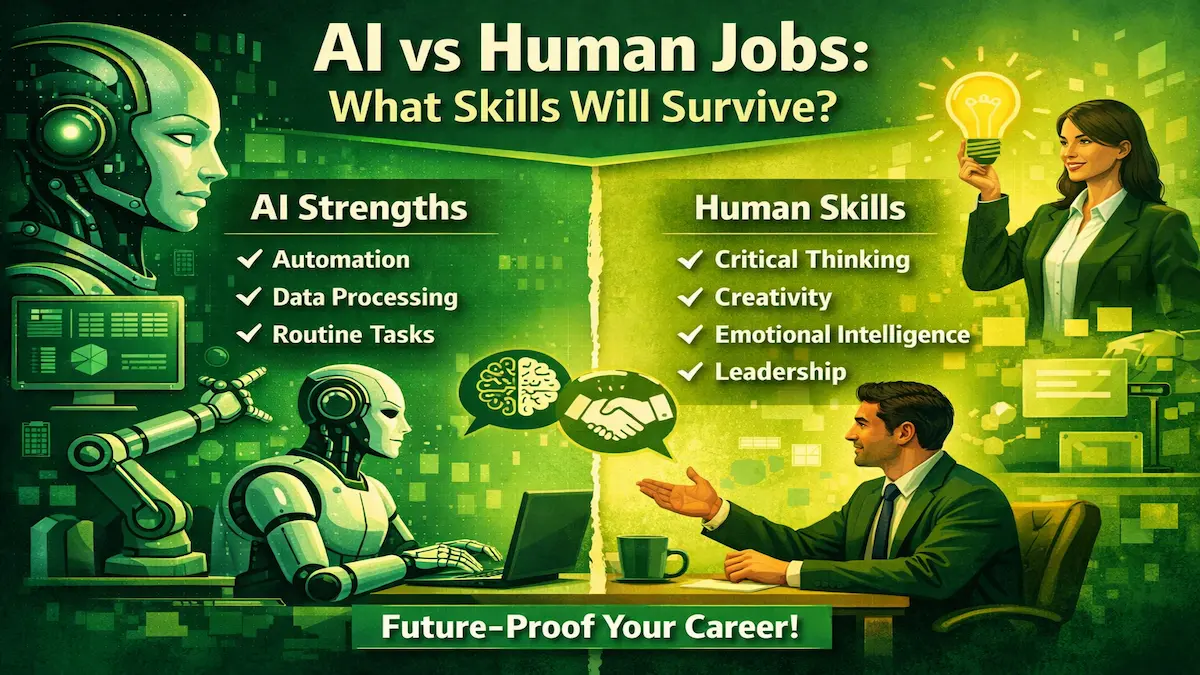
Artificial Intelligence is no longer a future concept. It is already changing how we work, learn, and earn. From automation tools to smart assistants, AI is entering almost every industry.
This raises a common fear: Will AI replace human jobs? The truth is more balanced. AI will replace some tasks, but human skills still matter more than ever.
In this guide, we explore which skills will survive the AI revolution and how you can future-proof your career.
Understanding AI and Job Automation
What AI Can Do Better Than Humans
AI excels at tasks that are repetitive, data-heavy, and rule-based. These jobs follow clear instructions and predictable patterns.
- Data entry and basic analysis
- Automated customer responses
- Image and speech recognition
- Routine quality checks
AI systems work fast, do not get tired, and can process massive amounts of data. That is why automation is growing rapidly.
What AI Still Struggles With
Despite its power, AI lacks human understanding, emotions, and judgment. It cannot truly think or feel like a person.
AI depends on data and instructions created by humans. Without human guidance, it cannot adapt meaningfully to complex life situations.
To understand AI’s role in daily life, Read more about how AI is changing daily life in 2026 .
Human Skills That Will Survive AI
Critical Thinking and Problem Solving
AI can suggest answers, but humans decide what truly matters. Critical thinking helps evaluate information and make smart decisions.
Future jobs will need people who can solve new problems, not just follow rules. This skill remains uniquely human.
Creativity and Original Thinking
AI can generate content, but originality still comes from humans. Creative thinking involves imagination, emotions, and cultural awareness.
Design, storytelling, innovation, and strategy rely on human creativity. These areas will continue to grow.
Emotional Intelligence and Empathy
Human connection cannot be automated. Empathy helps understand emotions, build trust, and resolve conflicts.
Jobs in healthcare, education, leadership, and counseling depend on emotional intelligence. AI cannot replace genuine human care.
Communication and Social Skills
Clear communication is essential in every industry. Explaining ideas, motivating teams, and negotiating require human presence.
Even in technical roles, strong communication increases career growth.
Ethical Judgment and Responsibility
AI does not understand morality. Humans must guide ethical decisions and ensure responsible technology use.
This makes ethics-based roles increasingly important in the AI era.
How Jobs Will Change, Not Disappear
AI as a Tool, Not a Replacement
Most jobs will evolve instead of disappearing. AI will handle repetitive tasks while humans focus on higher-level work.
For example, AI assists doctors, but human judgment saves lives.
New Careers Created by AI
AI also creates new job roles. These did not exist a few years ago.
- AI trainers and data annotators
- Automation specialists
- AI ethics advisors
- Prompt engineers
Learning to work with AI opens new career paths instead of closing doors.
How to Future-Proof Your Career
Step 1: Learn AI Basics
You do not need to become a programmer. Understanding how AI works is enough for most careers.
- Learn basic AI concepts
- Understand automation tools
- Use AI responsibly
Step 2: Strengthen Human Skills
Focus on skills that machines cannot copy easily. These skills increase long-term job security.
- Critical thinking
- Creativity
- Emotional intelligence
- Leadership
Step 3: Adopt Lifelong Learning
The job market will continue changing. Learning new skills regularly is no longer optional.
Online courses, self-learning, and real-world practice keep you relevant.
Key Benefits of Human-AI Collaboration
- Higher productivity with less stress
- Better decision-making
- New job opportunities
- More focus on meaningful work
- Improved work-life balance
Frequently Asked Questions (FAQ)
Will AI take all jobs?
No. AI will change jobs, not eliminate all of them. Human skills will always be needed.
Which jobs are safest from AI?
Jobs involving creativity, empathy, leadership, and complex decision-making are safest.
Do students need to fear AI?
No. Students who learn AI alongside human skills will have better opportunities.
Should I learn AI even in non-technical fields?
Yes. Basic AI understanding helps in marketing, education, healthcare, and business.
Conclusion
AI is transforming the workplace, but it is not the enemy of human jobs. Instead, it is a powerful tool that changes how work is done.
Skills like creativity, emotional intelligence, critical thinking, and ethics will always matter. Humans who adapt will thrive.
The future belongs to people who learn, evolve, and work alongside AI. Instead of fearing change, prepare for it.

